
Erectile Dysfunction (ED) is now viewed by healthcare professionals and researchers alike as a prevalent male sexual health issue affecting millions of men every year in all age groups worldwide. While it is an increasing occurrence as older men age, newer research has shown that there are many younger men with ED today, and this can be linked to lifestyle choices (such as diet and exercise), chronic medical illnesses, psychological issues and/or obesity, diabetes and/or heart disease, and many men also have a history of mental health problems.
Researchers, physicians, patients and caregivers need current and accurate statistics about ED to help them understand how frequently men encounter this issue, which men are finding it most frequently (through various demographic factors) and their history of risk factors related to developing erectile dysfunction, as well as which treatments have proven effective (have had high success rates) for treating men who have erectile dysfunction.
This comprehensive report combines data from all of the most current and trustworthy sources of research, worldwide prevalence estimates, demographics of men with ED, and treatment information from peer-reviewed medical literature and organizations. This report is recommended for anyone doing research on ED personally, for academic reasons, or for planning purposes to obtain a wide-ranging, evidence-based summary of effective treatment options for ED as of 2026.
Quick Summary: Erectile dysfunction affects millions of men globally, with prevalence increasing with age. However, it is not an inevitable part of aging and can often be managed successfully through lifestyle changes, medical treatment, and addressing underlying health conditions.
Table of Contents
- Top 10 Erectile Dysfunction Statistics in 2026
- What Is Erectile Dysfunction?
- Global Erectile Dysfunction Statistics
- Erectile Dysfunction by Age
- ED in Young Men
- Diabetes and Erectile Dysfunction Statistics
- Obesity and Erectile Dysfunction
- Heart Disease and Erectile Dysfunction
- Research Insights
The numbers behind ED give a good understanding to show how prevalent ED continues to be on men’s health globally. Below are
Top 10 Erectile Dysfunction Statistics in 2026
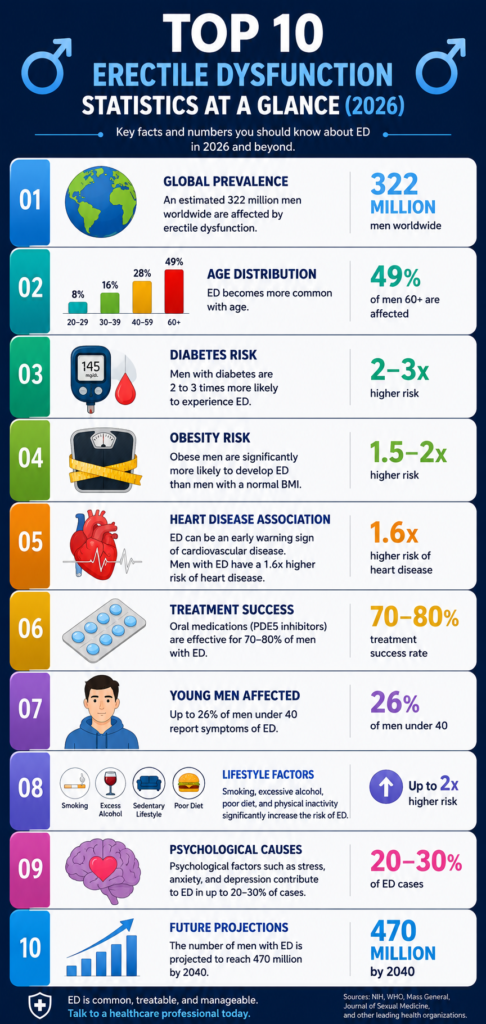
1. Over 300 million men globally will suffer from ED at some point.
The global burden of ED is related to population aging, and increases in rates of diabetes, obesity, and cardiovascular disease.
2. 50% of men ages 40-70 will experience some form of ED.
Research has shown that as men age there is a progressive increase in likelihood of developing ED. Different men may experience different degrees of ED.
3. ED happens to younger men as well.
Recent data have indicated that approximately 1/4th of newly diagnosed patients for ED are under 40 years of age, thus indicating that ED is becoming an increasing issue among the younger population.
4. Men with diabetes are at a higher risk to develop ED.
It is estimated that men who have diabetes are 2-3 times more likely to develop ED compared to men without diabetes because the longer you have diabetes, the more damages will occur to your nerves and blood vessels due to long-term elevation of your blood sugar.
5.Some of the common risk factors for CVD are also the common risks for ED.
Risk factors associated with CVD that will also be associated with the development of ED include: hypertension (high blood pressure), atherosclerosis, hyperlipidaemia (high cholesterol), obesity, smoking, and lack of exercise.
6. Erectile Dysfunction (ED) may appear before the symptom of heart disease shows up by years.
In some cases of men, ED can indicate the presence of vascular disease; thus, prompt medical evaluation will be essential.
7. Obesity is also associated with a greater likelihood of experiencing ED.
With excessive amounts of body fat, a person’s hormone levels may become unbalanced, inflamed, or both; low levels of testosterone; and circulation may be poor, all of which impact the ability of a male to have an erection.
8. Psychological factors still play a major role in the development of ED.
For many of the younger men diagnosed with ED, stress, anxiety, depression, relationship problems, performance anxiety, and others comprise a large portion of all cases of the problem.
9.The majority of men with ED will receive benefit from various treatment options.
Men diagnosed with ED can find improved ability to achieve and maintain an erection from such methods as lifestyle changes, medications, physical therapy, and appropriate treatment for any underlying health problems. One of the most commonly prescribed treatment options is Cenforce 100 mg for erectile dysfunction a Sildenafil-based medication that helps improve blood flow and supports men in achieving and maintaining an erection when taken under medical guidance.
10.The level of awareness and behavior regarding seeking treatment has improved.
Increased levels of public awareness about ED and additional chances for men to seek their doctors’ advice for problems such as ED via the internet are resulting in more men seeking and receiving the proper medical treatment for their problem than ever before.
What Is Erectile Dysfunction?
Erectile dysfunction (ED) is defined as the continued inability of a male to obtain or keep an erection adequate for satisfactory sex. Men may experience occasional difficulties achieving an erection and, while this is usually nothing to be concerned about, having ongoing problems may suggest the presence of an underlying illness or psychological disorder that should be evaluated.
Achieving an erection requires appropriate interaction between many systems in the body, including blood vessels, nerves, hormones, muscles, and the brain. Disruption of any of these interdependent systems can result in erectile dysfunction.
The following are some of the more common causes: coronary artery disease, diabetes, obesity, hypertension (high blood pressure), hyperlipidemia (high cholesterol), smoking, alcohol abuse, hormone disorders, depression, anxiety, some medications, neurological disorders, and many others.
In modern medicine, ED is more than just a sexual health issue. For men who are prescribed Sildenafil therapy, Aurogra 100 mg Sildenafil tablets are among the commonly available treatment options used to help manage erectile dysfunction. Many healthcare professionals see it as an indicator of one’s overall health; they believe that men with ED may have early vascular disease, metabolic syndrome, or endocrine disease before they show any other signs of these conditions.
Many men are reluctant to seek help for ED because they are embarrassed or have an incorrect belief that such problems are only experienced by older men. However, getting an early diagnosis can help improve quality of life by treating ED and also identifying a potentially serious medical condition that needs to be addressed immediately.
Erectile dysfunction is rapidly becoming a global public health issue. Worldwide, the aging population, rising rates of obesity, diabetes, hypertension, and poor diet and exercise are all contributing to the increase in the number of men with ED.
Data on the Global Epidemic of Erectile Dysfunction
The global epidemic of erectile dysfunction has become a major public health concern worldwide. As populations age and the prevalence of obesity, diabetes, hypertension, and sedentary lifestyles increases, so does the number of individuals who are affected by this condition.
While there are many variations in the reported prevalence of erectile dysfunction based upon study designs and characteristics of the population studied, researchers agree that millions of men across the globe are living with erectile dysfunction.
Major Global Trends
The number of men worldwide who will live with erectile dysfunction is projected to grow over the next few decades.
The largest group contributing to this growth in prevalence will be the aging population.
Increasing rates of lifestyle diseases (diabetes and obesity) is elevating the risk of erectile dysfunction even in younger adults.
Increased awareness has led to an improved rate of diagnosis and treatment in many countries.
Access to healthcare and cultural attitudes about erectile dysfunction, however, continue to influence how many men report the condition globally.
| Region | Estimated Trend |
|---|---|
| North America | High diagnosis rates due to better healthcare access |
| Europe | Increasing prevalence with aging populations |
| Asia | Rapid growth linked to urban lifestyles and diabetes |
| Middle East | Rising prevalence associated with metabolic disorders |
| Latin America | Improved awareness but underreporting remains common |
| Africa | Limited epidemiological data; prevalence likely underestimated |
Erectile Dysfunction Statistics Based on Age
Age is a major indicator of erectile dysfunction (ED); however, it is not the sole determiner of ED. Numerous medical studies show that with age ED increases as a result of aged-related vascular health deterioration, as well as changes in hormone levels, nerve function, and an increase in chronic diseases (e.g., Diabetes, hypertension, and cardiovascular diseases). Although statistically, ED increases with the aging process ED is not considered a normal or an expected part of aging.
One of the early significant studies on ED, Massachusetts Male Aging Study (MMAS), found that 52% of men between 40 and 70 years of age reported having some degree of ED; moreover, 17.2% reported having minimal ED, 25.2% reported having moderate ED and 9.6% reported having complete ED.
In addition to the MMAS study, the U.S. National Institute of Diabetes and Digestive and Kidney Diseases (NIDDK) notes that approximately 40% of men are affected by ED at age 40 years old; furthermore, around 70% of men report having some degree of ED at age 70 years old. These statistics indicate that there is a strong correlation between age and ED.
Age-Related Erectile Dysfunction Statistics
Instead of presenting exact percentages for every decade—which vary between studies—use evidence from major research.
| Age Group | Evidence-Based Findings |
|---|---|
| Under 40 years | ED occurs but is less common; reported prevalence varies considerably across studies. |
| 40–70 years | 52% of men have some degree of ED (MMAS). |
| Age 40 | Around 40% of men report ED. |
| Age 70 | Around 70% of men report ED. |
Expert Insight: Age increases the likelihood of ED, but underlying health conditions such as diabetes, obesity, smoking, and cardiovascular disease often have a greater impact on erectile function than age alone
What Causes E.D. To Become More Common As Men Age?
There Are Currently Several Types Of Factors Which Are Thought To Be Influencing This Increase In E.D. Rates. For Example:
- A Decrease Of Elasticity In Blood Vessels As Well As A Decrease Of Blood Flow.
- Increasing Number Of Men With Hypertension And Atherosclerosis.
- Nerve Damage And Vessel Damage (Vascular Disease) Caused By Diabetes.
- Hormonal Changes — Especially The Decline Of Testosterone Levels In Many/Some Middle Aged Men.
- Increased Use Of Various Medications That Can Affect E.D.
- Increased Prevalence Of Other Types Of Chronic Diseases, Including Chronic Kidney Disease, Obesity, And Cardiovascular Disease.
E.D. Is Also An Issue For Young Men
Persistent erectile dysfunction at any age warrants medical evaluation. Depending on the underlying cause, healthcare professionals may recommend different medications. Medicine like Avana 100 mg dose contain Avanafil, a fast-acting PDE5 inhibitor prescribed for treating erectile dysfunction in appropriate patients.
Although E.D. Is More Common Among Older Adults, Its Also An Issue For Some Younger Men. In Fact, Research Has Shown That Approximately 26% Of Those Men Who Were Assigned A Diagnosis Of E.D. Were 40 Years Or Younger At Time Of Diagnosis; And It’s Important To Note That This Statistic Is From A Study Conducted In An E.D. Clinic — Not For The General Male Population.
For Instance, The European Association Of Urology (E.A.U.) States That 1 Out Of Every 4 People Who Present With A Newly Diagnosed E.D. At Their Doctor’s Office Are Younger Than 40 Years Old; Therefore, The Evidence Indicates That There Are E.D. Patients Who Are Under 40 Years Old In All Types Of Clinical Settings.
However, The Population Based Studies Have Shown A Great Deal Of Variation In Prevalence Of E.D. Among Younger Men. Various Definitions And Survey Methods Are Used By The Different Studies, Leading To The Discrepancies.
The evidence shows that while ED becomes more common with age, it is not exclusively an older man’s condition. Persistent erectile dysfunction at any age warrants medical evaluation because it may be an early indicator of conditions such as diabetes, hypertension, or cardiovascular disease. Early diagnosis and management of underlying risk factors can improve both sexual function and overall health.
Prevalence of Erectile Dysfunction Among Diabetic Men
Erectile dysfunction (ED) can be directly connected to diabetes as a majority of individuals living with diabetes over the age of 18 experience some form of ED. In recent reports, individuals living with any type of diabetes were noted to be 2-3x more likely to develop ED than individuals without diabetes.
Additionally, these individuals typically develop ED 10-15 years earlier than other individuals. In findings of research performed by the National Institute of Diabetes and Digestive and Kidney Diseases (NIDDK), it was determined that individuals living with diabetes had an overall prevalence of ED estimated at approximately 52.5%. The prevalence of ED based on diabetes type included in the analysis is detailed here:
| Diabetes Type | Estimated ED Prevalence |
|---|---|
| Overall diabetes | 52.5% |
| Type 2 diabetes | ~66.3% |
| Type 1 diabetes | ~37.5% |
These findings demonstrate that ED is one of the most common long-term complications of diabetes.
How Does Diabetes Contribute To The Development Of Ed?
Men With Diabetes Are 2–3 Times More Likely Than Non-Diabetic Men To Develop Ed; Ed In Men With Diabetes Often Develops 10–15 Years Earlier Than In Men Without Diabetes; Good Control Of Blood Sugar Is Associated With A Lower Risk Of Developing Complications From Diabetes, Including Ed.
There Are Several Ways That Diabetes Can Lead To Ed:
- Damage To Blood Vessels
As A Result Of The Development Of The Early Stages Of Kidney Disease, High Blood Glucose Levels Cause Damage To The Lining Of Blood Vessels (Endothelium), Resulting In Decreased Blood Flow Needed To Achieve An Erection.
- Damage To Nerves (Diabetic Neuropathy)
Diabetes Can Result In Damage To The Nerves That Transmit Messages To The Penis To Achieve An Erection.
- Decreased Production Of Nitric Oxide
Nitric Oxide Produces Relaxation/Smooth Muscle Relaxation Of The Blood Vessels To Allow Blood Flow During Sexual Arousal. Diabetes Can Decrease The Amount Of Nitric Oxide Produced, Making It More Difficult To Achieve An Erection.
- Hormone Changes
Obesity Associated With Type 2 Diabetes And Insulin Resistance May Lead To Decreased Testosterone Levels In Some Men.
Sources:
- NIDDK
- Kouidrat Y, et al. Diabetic Medicine. 2017.
Obesity & Erectile Dysfunction Stats
The global obesity epidemic has resulted in a serious public health issue that also has a direct connection to erectile dysfunction. There are multiple ways that excess fat can affect the erectile process, including chronic inflammation, a decrease in testosterone, insulin resistant, poor circulation, and increased cardiovascular risk.
According to a systematic review from The Journal of Sexual Medicine, there is a significantly higher proportion (over 50%) of overweight/obese males who report having problems with erectile function than those who are at a healthy body mass index.
Additional research shows that men with erectile dysfunction due to being overweight or having metabolic syndrome will see improvements in ED symptoms with even modest weight loss combined with an exercise program.
Effects of Obesity on ED
Chronic Inflammation
- Obesity can increase levels of inflammatory markers in the body that damage blood vessels and block nitric oxide production.
- Excess fat may cause the body to convert testosterone into estrogen, which will decrease libido and cause problems with erectile function.
- Obesity places an individual at a higher risk of developing hypertension, diabetes, and elevated cholesterol, all of which play a significant role in developing erectile dysfunction.
- Insulin Resistance has a substantial relationship to endothelial dysfunction, and these two conditions can significantly decrease the ability of the blood vessels in the body to function properly.
Research Results
The European Association of Urology (EAU) has identified obesity as one of the leading modifiable risk factors for erectile dysfunction; therefore, weight reduction is strongly recommended.
A randomized clinical trial by Esposito et al. (JAMA, 2004) found that lifestyle changes—including weight loss, exercise, and dietary improvements—significantly improved erectile function in obese men with ED.
What You Understood
- Obesity increases the likelihood of erectile dysfunction.
- Weight reduction improves erectile function in many men.
- Lifestyle interventions remain a cornerstone of ED prevention.
Association between erectile dysfunction and cardiovascular disease.
Cardiovascular disease, which is the leading cause of death in America, is also associated with multiple factors, including high cholesterol, hypertension, diabetes, tobacco use, obesity, lack of exercise, and metabolic syndrome.
Both cardiovascular disease and erectile dysfunction can be influenced by the following:
- High Blood Pressure: Hypertension can damage arteries, making them less able to expand and contract properly, and leading to decreased blood flow, making it harder for men to achieve a full erection.
- Diabetes: Diabetes can damage nerves and small blood vessels. Nearly 40% of diabetic men experience erectile dysfunction at some point in their lives. Men who have diabetes are also at an increased risk for developing cardiovascular disease, particularly if they have poor blood sugar control or other risk factors for developing cardiovascular disease.
- High Cholesterol: High cholesterol can contribute to plaque buildup inside arteries (atherosclerosis) and can lead to cardiovascular disease. Men who have high LDL cholesterol levels (bad cholesterol) are at a higher risk for developing cardiovascular disease than men with low LDL cholesterol levels.
- Smoking: Smoking can damage blood vessels, reduce circulation, increase the risk of heart disease and contribute to erectile dysfunction.
- Obesity: Obese men tend to experience high blood pressure, high cholesterol and are at a greater risk of developing cardiovascular disease. Obese men are also more likely than non-obese men to experience erectile dysfunction.
- Physical Inactivity: Inactivity often leads to obesity, but inactivity alone can also contribute to erectile dysfunction. Regular exercise improves circulation, increases testosterone levels, and decreases the risk of developing cardiovascular disease.
- Metabolic Syndrome: Metabolic syndrome is a group of conditions that occur together, increasing the risk of heart disease, stroke, and diabetes. Conditions that contribute to metabolic syndrome include high blood pressure, high cholesterol, obesity, and insulin resistance. Metabolic syndrome is associated with a higher risk of erectile dysfunction.
Research Results to Keep in Mind
Multiple meta-analyses show that men with erectile dysfunction (ED) have a higher risk of:
- Coronary artery disease (CAD)
- Heart attack (acute myocardial infarction)
- Heart Stroke
- Renal failure
Even though the individual risks differ for each of these diseases, these statistics demonstrate that ED may represent an indicator of overall vascular health rather than just one isolated condition.
Expert Commentary
The evidence is clear: erectile dysfunction is often more than a quality-of-life issue. It can be an early clinical sign of underlying vascular disease or metabolic disorders. Men experiencing persistent ED should not only seek treatment for sexual function but also undergo evaluation for diabetes, hypertension, lipid disorders, and other cardiovascular risk factors. Early detection and management of these conditions can improve both sexual health and long-term cardiovascular outcomes.
Sources
- NIDDK – Erectile Dysfunction: Definition & Facts.
- Kouidrat Y, et al. High prevalence of erectile dysfunction in diabetes: Diabetic Medicine. 2017.
- European Association of Urology (EAU) – Sexual and Reproductive Health Guidelines.
- Esposito K, et al. Effect of Lifestyle Changes on Erectile Dysfunction in Obese Men. JAMA. 2004.
- Princeton Consensus Conference recommendations on ED and cardiovascular disease.
- Montorsi P, et al. The artery size hypothesis.
- American Heart Association statements on cardiovascular risk and ED.

Dr. Olivia, MD
Men’s Health & Sexual Wellness Advisor
Dr. Olivia, MD, focuses on female and male’s health, sexual wellness, and evidence-based health education, with interests spanning reproductive wellness, lifestyle, nutrition, fitness, and chronic health management.
Reviewed for medical accuracy and educational clarity.